

India’s 93-run victory over Namibia in Delhi was the result most people predicted, yet the game left behind a lot of figures worth a closer look. This report goes through the main batting and bowling performances, the moments that decided the contest and the effect on the Group A standings.
India won by 93 runs · Hardik Pandya was Player of the Match
Match Overview
The game was Match 18 of the ICC Men’s T20 World Cup 2026, played under lights at the Arun Jaitley Stadium on 12 February 2026. Namibia won the toss and chose to bowl, expecting the evening air to help them in the chase. India piled up 209/9, and Namibia were dismissed for 116 in 18.2 overs.
For a complete record of the innings, the India national cricket team vs Namibia national cricket team stats page lists every detail of the scorecard, while this article focuses on the numbers that shaped the result.
Match Snapshot
| Detail | Information |
|---|---|
| Fixture | India vs Namibia, Match 18, Group A |
| Venue | Arun Jaitley Stadium, Delhi |
| Toss | Namibia won, chose to field |
| India | 209/9 (20 overs) |
| Namibia | 116 all out (18.2 overs) |
| Result | India won by 93 runs |
| Player of the Match | Hardik Pandya (52 off 28, 2/21) |
| Captains | Suryakumar Yadav (India), Gerhard Erasmus (Namibia) |
| Match officials | Paul Reiffel, Rod Tucker (on-field); Leslie Reifer (TV); Andy Pycroft (referee) |
India’s Innings: Fast Start, Wobble, Strong Finish
Namibia’s choice to field first backfired quickly. Sanju Samson smashed 22 from only 8 balls, including three sixes, a strike rate of 275, before Louren Steenkamp caught him off Ben Shikongo with India on 25/1. His burst freed Ishan Kishan to play his natural game at the other end.
Kishan dominated the early overs. He scored 61 from 24 deliveries, striking six fours and five sixes at 254.17. When Shikongo caught him off Gerhard Erasmus in the eighth over, the scoreboard already read 104/2. Very few sides can come back after conceding that much in seven overs, and Namibia never recovered their composure.
The middle phase brought a slowdown. Suryakumar Yadav was stumped for 12 from 13 balls, and Tilak Varma built a steady 25 off 21 before departing at 124/4 in the 12th over. Namibia’s bowlers fought back for a spell, and a finish near 180 seemed more realistic than 200.
Hardik Pandya turned that around. His 52 came off 28 balls with four fours and four sixes, a strike rate of 185.71. Shivam Dube chipped in with a lively 23 from 16, and together they lifted India to 205 before wickets tumbled at the death. Pandya, Dube and Axar Patel went within a few deliveries, Rinku Singh and Arshdeep Singh followed, and Arshdeep was run out off the last ball to leave India on 209/9.
India’s Leading Batters
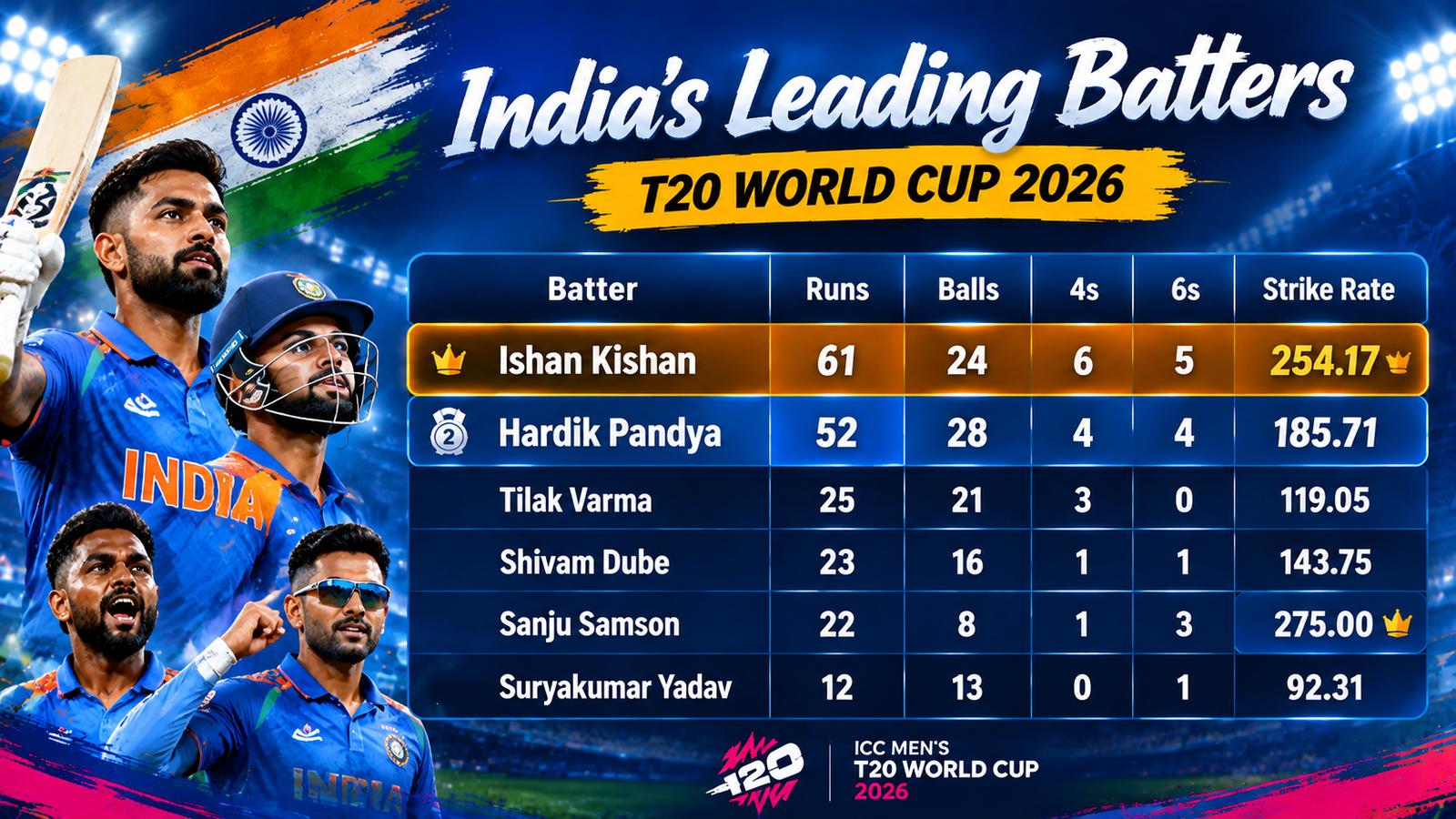
| Batter | Runs | Balls | 4s | 6s | Strike Rate |
|---|---|---|---|---|---|
| Ishan Kishan | 61 | 24 | 6 | 5 | 254.17 |
| Hardik Pandya | 52 | 28 | 4 | 4 | 185.71 |
| Tilak Varma | 25 | 21 | 3 | 0 | 119.05 |
| Shivam Dube | 23 | 16 | 1 | 1 | 143.75 |
| Sanju Samson | 22 | 8 | 1 | 3 | 275.00 |
| Suryakumar Yadav | 12 | 13 | 0 | 1 | 92.31 |
How Namibia’s Bowlers Fared
Erasmus was the lone bowler to restrict India. He returned 4/20 from four overs at an economy of 5.00, claiming Kishan, Tilak, Pandya and Axar. Every other bowler conceded at least 9.50 per over. Ruben Trumpelmann gave up 38 in four overs, Bernard Scholtz 41 in four, JJ Smit 50 in four and Shikongo 41 in three, while Max Heingo’s lone over went for 18.
Namibia’s Reply: A Promising Start Undone by Spin
Chasing 210 demands a quick start and a major partnership. Namibia delivered the first for a short time and never managed the second.
Jan Frylinck made 22 from 15 before Dube caught him off Arshdeep at 33/1. Steenkamp carried on and top-scored with 29 off 20, hitting three fours and a six. At 67/1 after seven overs, the target looked a long way off but not entirely out of reach.
Varun Chakravarthy ended those hopes. He bowled Steenkamp at 67/2, got Jan Nicol Loftie-Eaton caught by Axar for 13 and bowled JJ Smit for a duck within a couple of deliveries. Namibia were suddenly 86/4, and then 88/5 when Tilak held a catch to remove Erasmus off Axar. Erasmus had struck 18 from 11 with two sixes, so his exit took away Namibia’s last big hitter. Varun’s figures of 3/7 from two overs were the tightest of the night.
The lower order added little. Malan Kruger made 5 off 10 before Bumrah caught him off Axar, and Trumpelmann scored 6 from 16 before Bumrah bowled him. Pandya then took two wickets in two balls, Scholtz and Shikongo, to leave Namibia on 116/9. Zane Green’s 11 off 19 ended by hit wicket against Dube, and the innings closed on 116 in the 19th over.
India’s Bowling Summary
| Bowler | Overs | Maidens | Runs | Wickets | Economy |
|---|---|---|---|---|---|
| Varun Chakravarthy | 2 | 0 | 7 | 3 | 3.50 |
| Hardik Pandya | 4 | 0 | 21 | 2 | 5.25 |
| Axar Patel | 3 | 1 | 20 | 2 | 6.66 |
| Jasprit Bumrah | 4 | 0 | 20 | 1 | 5.00 |
| Shivam Dube | 2.2 | 0 | 11 | 1 | 4.71 |
| Arshdeep Singh | 3 | 0 | 36 | 1 | 12.00 |
Six bowlers split the ten wickets, and five of them conceded fewer than seven an over. Arshdeep’s economy of 12.00 was the only real weakness, although he did dismiss Frylinck. Axar’s maiden in the middle overs was also valuable, because Namibia were trying to rebuild after losing Loftie-Eaton and Smit and those dot balls drained their momentum.
Side-by-Side Comparison
Comparing the two innings shows just how lopsided the game was.
| Category | India | Namibia |
|---|---|---|
| Total | 209/9 | 116 |
| Run rate | 10.45 | 6.33 |
| Fours | 15 | 9 |
| Sixes | 14 | 4 |
| Runs from boundaries | 144 | 60 |
| Fifties | 2 | 0 |
| Best batter | Ishan Kishan (61) | Louren Steenkamp (29) |
| Best bowler | Varun Chakravarthy (3/7) | Gerhard Erasmus (4/20) |
India hit 19 more boundaries and gained 84 more runs from them, nearly the whole winning margin. Their scoring rate was also more than four runs an over faster than Namibia’s.
The Moments That Decided the Match
Four passages of play settled the outcome:
- The opening seven overs. India reached 104/1 in that period, laying the foundation for a massive score.
- The revival from 124/4. Pandya and Dube lifted the tempo again and converted an average total into a formidable one.
- Varun’s middle-over spell. Three wickets for seven runs dragged Namibia from 67/1 to 86/4 and effectively ended the chase.
- Pandya’s double strike. Two wickets in consecutive balls left Namibia at 116/9 and locked in the margin.
A Responsible Note for Fans
Plenty of followers study scorecards to understand form and conditions, and some go on to look up a Betting ID in India. Online betting is restricted or prohibited in much of the country, and rules differ from state to state, so check your local laws and avoid unlicensed platforms. A scorecard is best used for what it was built for: following the sport and appreciating how a match was won.
Why Pandya Took the Award
Kishan’s innings was the most destructive and Varun’s spell the most economical, but Pandya made an impact in both innings. His 52 supplied the late acceleration India needed, and his two quick wickets closed out Namibia’s innings. Afterwards, Pandya said he had spent time in a training camp before the tournament and felt well prepared, according to the post-match notes on ESPNcricinfo.
Group A: What the Win Changed
The victory helped India complete the group stage unbeaten, and the boost to their net run rate was considerable.
| Team | Played | Won | Lost | Points | NRR |
|---|---|---|---|---|---|
| India | 4 | 4 | 0 | 8 | 2.500 |
| Pakistan | 4 | 3 | 1 | 6 | 0.976 |
| USA | 4 | 2 | 2 | 4 | 0.788 |
| Netherlands | 4 | 1 | 3 | 2 | -1.217 |
| Namibia | 4 | 0 | 4 | 0 | -3.108 |
India’s NRR of 2.500 was the best in the group by a distance, and this 93-run margin played a major part. Namibia ended with the weakest NRR in Group A.
India took that form into the knockouts. They beat Zimbabwe by 72 runs and West Indies by five wickets in the Super 8s, then edged England by 7 runs in a high-scoring semi-final. They finished the tournament with a 96-run win over New Zealand in the final. The Namibia game was an early sign of the batting depth and bowling variety that defined their campaign.
What Each Side Can Learn
India
The batting unit showed it can adjust. When wickets fell in the middle overs, others delivered, and six batters reached double figures. Varun, Axar and Dube took six of the ten wickets, a reassuring sign for slower surfaces. The one concern was Arshdeep’s economy, which the management will want to fix.
Namibia
Erasmus stood out with four wickets and a rapid 18, and the opening batters proved they can hold their own for a few overs against a top-class attack. The weaknesses were just as clear: too many runs leaked at the death, too many wides, and a middle order that could not rebuild after losing wickets in clusters. Facing Bumrah, Varun and Axar is a rare experience for Associate players, and it should serve them well in future qualifiers.
Frequently Asked Questions
Who won the India vs Namibia match in the T20 World Cup 2026?
India won by 93 runs at the Arun Jaitley Stadium in Delhi on 12 February 2026.
Who was Player of the Match?
Hardik Pandya, for 52 off 28 balls and figures of 2/21.
Who scored the most runs?
Ishan Kishan made 61 off 24 balls. Louren Steenkamp top-scored for Namibia with 29.
Who took the most wickets?
Gerhard Erasmus took 4/20 for Namibia. For India, Varun Chakravarthy took 3/7.
How many sixes were hit in the game?
Eighteen in total: 14 by India and 4 by Namibia.
Final Verdict
The numbers reveal a wide gap. India scored at over ten an over, hit more than three times as many sixes and needed six bowlers to take all ten wickets. Namibia competed for around seven overs before losing control against the spin of Varun and Axar. It was a statement win for India and a boost to their run rate, and a tough but useful lesson for Namibia.
 Get WhatsApp ID Now