
What happens when India’s most celebrated cricketers from different eras come together in a single playing XI? This carefully balanced team features technically gifted batters, match-winning bowlers, an outstanding wicketkeeper and a legendary all-rounder.
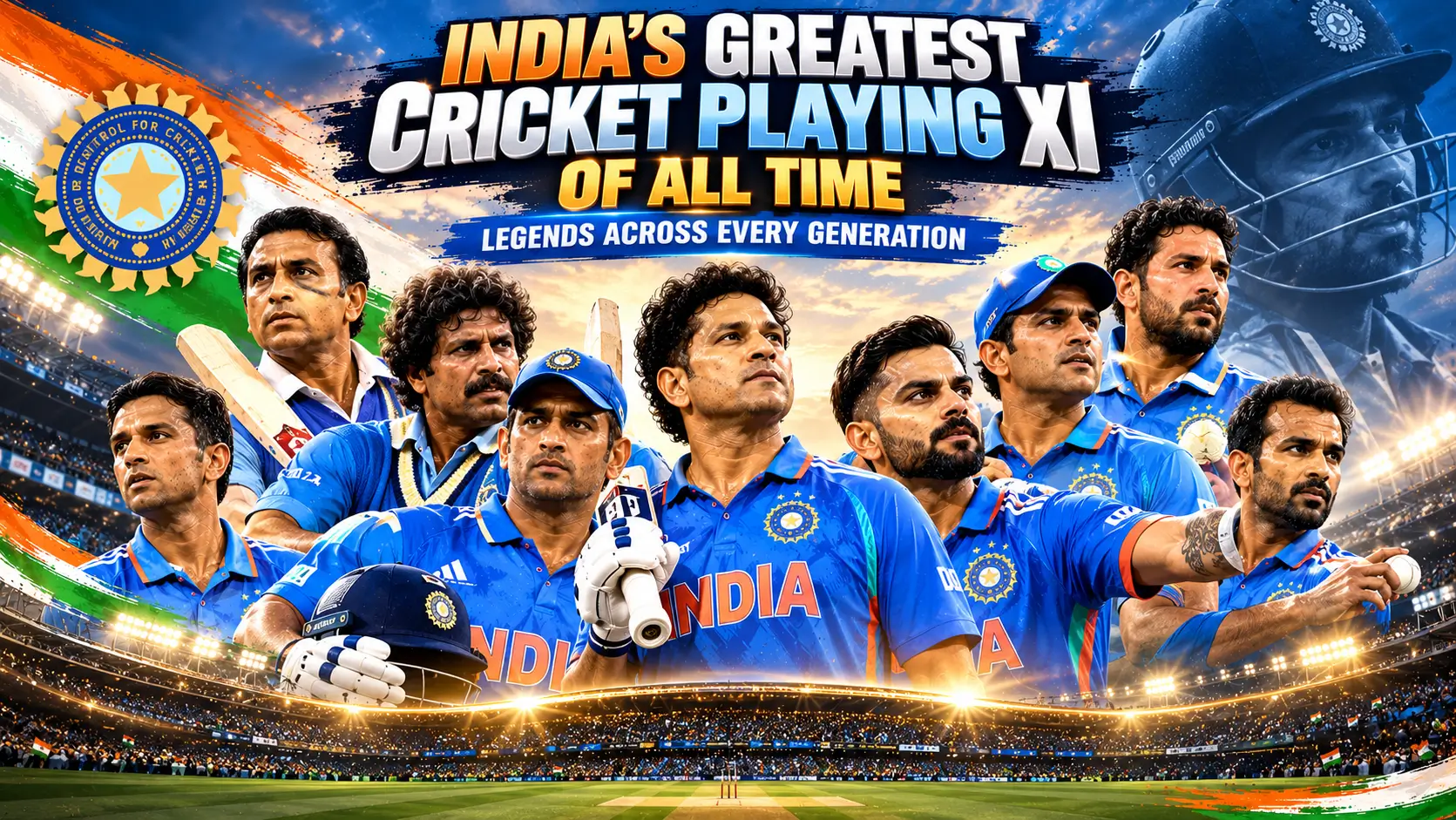
Indian cricket has produced extraordinary talent across generations. Sunil Gavaskar established new standards for opening batting, Kapil Dev inspired a World Cup triumph, Sachin Tendulkar became a global icon, and Virat Kohli brought new intensity to modern cricket. Selecting just eleven players from this history is difficult because conditions, formats and opposition have changed dramatically.
This selection primarily uses Test cricket as a common standard, with major limited-overs achievements considered as additional context. The objective is to build a functioning team rather than simply choose the eleven most famous names.
India’s Greatest Cricket Playing XI: Complete Team
| No. | Player | Role | Greatest strength |
|---|---|---|---|
| 1 | Sunil Gavaskar | Opener | Technique against fast bowling |
| 2 | Virender Sehwag | Opener | Attacking starts |
| 3 | Rahul Dravid | Top-order batter | Patience and stability |
| 4 | Sachin Tendulkar | Middle-order batter | Complete stroke play |
| 5 | Virat Kohli | Middle-order batter | Intensity and consistency |
| 6 | MS Dhoni (C, WK) | Wicketkeeper-batter | Leadership and composure |
| 7 | Kapil Dev | Pace-bowling all-rounder | Team balance |
| 8 | Ravichandran Ashwin | Spin-bowling all-rounder | Variation and control |
| 9 | Anil Kumble | Leg-spinner | Wicket-taking consistency |
| 10 | Zaheer Khan | Left-arm fast bowler | Swing and reverse swing |
| 11 | Jasprit Bumrah | Fast bowler | Precision and adaptability |
1. Sunil Gavaskar – The Original Little Master
Sunil Gavaskar transformed expectations of Indian batting. His balance, technique and concentration helped him succeed against formidable pace attacks in an era when batting protection and playing conditions were different from today. The first batter to reach 10,000 Test runs, Gavaskar completed his career with 10,122 runs and 34 centuries.
His inclusion gives this XI a traditional opener who can withstand the new ball, protect the middle order and bat for long periods. A determined Gavaskar at one end also frees his partner to play more aggressively.
2. Virender Sehwag – Fearless Attacking Opener
Virender Sehwag challenged the assumption that Test openers must start cautiously. He frequently attacked from the beginning, putting bowlers under pressure before they could settle. His 8,586 Test runs and 23 centuries include two triple hundreds: 309 against Pakistan and 319 against South Africa.
Sehwag and Gavaskar would be an extraordinary pairing. One provides defensive certainty; the other changes the pace of a match in a single session. Together, they offer both resilience and the possibility of rapid, intimidating starts.
3. Rahul Dravid – The Wall
Rahul Dravid’s career was built on persistence, preparation and remarkable control. With 13,288 Test runs and 36 centuries, he was central to many of India’s finest overseas performances. His ability to bat through difficult spells earned him the nickname “The Wall.”
At No. 3, Dravid is essential insurance against an early wicket. He can absorb pressure on challenging surfaces, form long partnerships and ensure attacking players have a stable platform. His selfless approach adds a valuable team-first mentality.
4. Sachin Tendulkar – The Master Batter
Sachin Tendulkar is one of cricket’s most recognisable figures and an obvious choice for India’s all-time XI. Over 200 Tests, he accumulated 15,921 runs and 51 centuries. Across international formats he recorded 100 centuries, an extraordinary achievement of longevity and sustained excellence.
Tendulkar succeeded against leading bowling attacks over multiple eras. His straight drive became iconic, but his true value lay in his ability to adapt and score in varied conditions. At No. 4, he anchors this side’s strongest batting partnerships and gives it unmatched experience.
5. Virat Kohli – The Modern-Day Champion
Virat Kohli redefined expectations around fitness, intensity and fast-bowling support in Indian cricket. He finished his Test career with 9,230 runs and 30 centuries, while also making a major impact on limited-overs cricket. His determination during overseas contests helped shift India’s mindset toward competing aggressively in every environment.
Kohli’s placement at No. 5 adds energy and high-quality batting after Tendulkar and Dravid. Cricket fans researching his form often move between statistical reports, match discussion sites and wider online searches, including commercial terms such as Trusted Online Betting ID. Those searches should be distinguished from verified performance statistics used to judge his cricketing legacy.
6. MS Dhoni – Wicketkeeper and Captain
MS Dhoni is selected as both wicketkeeper and captain. His calm judgment helped guide India to the 2007 T20 World Cup, 2011 ODI World Cup and 2013 Champions Trophy. He also scored 4,876 Test runs and offered fast hands and excellent awareness behind the stumps.
In this side, Dhoni provides lower-middle-order stability and tactical leadership. He can adapt to situations demanding patient defence or counterattacking strokes. His ability to manage high-pressure decisions is especially useful in a team featuring so many strong individual personalities.
Online conversations around India’s major cricket victories sometimes extend beyond match analysis into commercial queries such as best betting id in India. Such a term describes a service search, not an endorsement or a criterion for choosing the greatest cricketers.
7. Kapil Dev – The Complete All-Rounder
Kapil Dev reshaped Indian cricket by showing that India could win through world-class pace bowling. He captained the nation to the historic 1983 World Cup title and finished his Test career with 5,248 runs and 434 wickets. His athleticism, natural swing bowling and useful lower-order batting made him exceptional.
His unbeaten 175 against Zimbabwe in the 1983 World Cup remains a celebrated example of a player transforming a seemingly lost contest. At No. 7, Kapil gives this XI the freedom to field three specialist fast bowlers and two premier spinners without abandoning batting depth.
8. Ravichandran Ashwin – The Tactical Spin Master
Ravichandran Ashwin was among modern cricket’s most thoughtful bowlers. He ended his Test career with 537 wickets in 106 matches, using changes of pace, flight, angle and spin to outsmart batters. His six Test centuries also make him an invaluable lower-order contributor.
Ashwin would be particularly effective alongside Anil Kumble because their methods challenge batters differently. On turning tracks, he could attack relentlessly; on less helpful pitches, his precision and tactical adjustments would still support the pace attack.
9. Anil Kumble – India’s Leading Test Wicket-Taker
Anil Kumble’s 619 Test wickets remain the highest total by an Indian bowler. Although classified as a leg-spinner, he was known for accuracy, bounce and a relentless ability to maintain pressure. His ten wickets in a single innings against Pakistan in Delhi in 1999 are among cricket’s most memorable bowling achievements.
Kumble contributes tireless competitiveness and a proven ability to win long-format matches. Combined with Ashwin, he supplies both variety and sustained control across extended spells.
10. Zaheer Khan – Left-Arm Swing Specialist
Zaheer Khan brought left-arm variety, conventional swing and reverse swing to India’s pace attack. He collected 311 Test wickets and became a trusted leader of the bowling unit. His crucial performances in the 2011 World Cup also underline his ability to deliver on major occasions.
Zaheer’s angle complements right-arm bowlers Kapil Dev and Jasprit Bumrah. Against top-order batters, that variety is invaluable: the ball arrives from different angles, creating new challenges in defence and footwork.
11. Jasprit Bumrah – The Precision Fast Bowler
Jasprit Bumrah represents the evolution of Indian fast bowling. His distinctive action, control of line and length, sharp yorkers and ability to exploit movement make him dangerous across surfaces and formats. His 71 Test wickets in 2024 were a remarkable demonstration of his match-winning influence.
In this XI, Bumrah takes the new ball alongside Zaheer and returns for decisive spells. His ability to create breakthroughs when the game appears settled gives India a powerful option against elite opposition.
Graph 1: Comparing India’s Greatest Test Batters
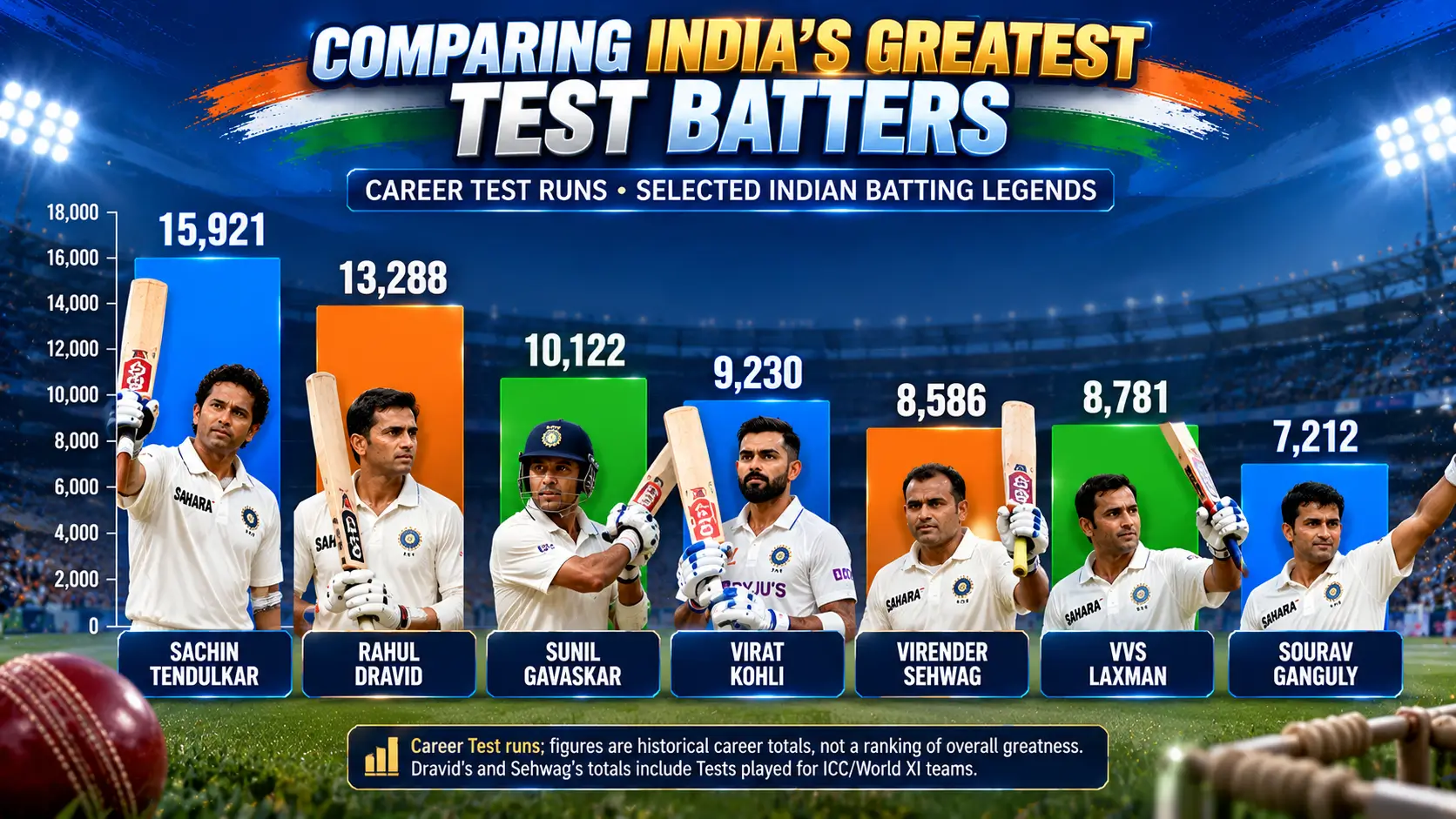
Career run totals offer one useful measure of sustained excellence, though matches played, historical conditions and roles must also be considered.
Career Test runs
Completed career totals; bar lengths scaled to Tendulkar’s record.
| Batter | Test runs | Test centuries |
|---|---|---|
| Sachin Tendulkar | 15,921 | 51 |
| Rahul Dravid | 13,288 | 36 |
| Sunil Gavaskar | 10,122 | 34 |
| Virat Kohli | 9,230 | 30 |
| Virender Sehwag | 8,586 | 23 |
Tendulkar leads this group in both runs and centuries, while Dravid’s tally highlights his tremendous longevity. Gavaskar’s success must be viewed within the demanding context of his era. Sehwag shows that a contrasting, aggressive approach can also deliver exceptional Test results.
Graph 2: India’s Legendary Test Bowlers Compared
India’s bowling identity evolved from spin-heavy attacks to units capable of winning with high-class pace and spin on a wide range of surfaces.
Career Test wickets
Completed career totals for retired players; bar lengths scaled to Kumble’s record.
Kumble and Ashwin illustrate India’s extraordinary spin-bowling tradition. Kapil and Zaheer demonstrate the importance of pace across decades, while Bumrah represents a modern standard of fast-bowling precision. As his career record may continue to change, he is not included in this fixed retired-player comparison.
Who Should Captain India’s All-Time Test Playing XI?
Kapil Dev, Virat Kohli and MS Dhoni each offer a persuasive leadership case. Kapil inspired India to its first World Cup win; Kohli built an aggressive Test identity; Dhoni managed pressure with exceptional calm during major international tournaments.
For this combined-era team, MS Dhoni is the captain and Virat Kohli the vice-captain. Dhoni’s tactical flexibility makes him a strong choice for a squad of established stars, while Kohli’s aggressive mindset adds a valuable counterbalance. If the exercise were strictly based on Test captaincy, Kohli would deserve particularly serious consideration.
Honourable Mentions: Legends Who Narrowly Missed Out From The Test Playing XI
| Player | Selection case |
|---|---|
| Sourav Ganguly | Transformational captain and left-handed batter |
| VVS Laxman | Exceptional performances under pressure |
| Rohit Sharma | Outstanding white-ball opener and successful Test batter |
| Yuvraj Singh | Major limited-overs tournament contributions |
| Ravindra Jadeja | Outstanding all-round value and fielding |
| Harbhajan Singh | 417 Test wickets and memorable spells |
| Mohammed Shami | Elite seam movement and attacking fast bowling |
A white-ball-focused XI would give Rohit Sharma and Yuvraj Singh much stronger claims. Jadeja, meanwhile, has an excellent argument in any team prioritising fielding and left-arm spin alongside lower-order batting.
How India’s Cricket Legacy Inspires Fans Today
Indian cricket now connects generations through match archives, scorecards, statistics and analytical discussions. Comparing players fairly means considering conditions, formats and team roles rather than simply sorting careers by total runs or wickets.
Digital audiences also encounter cricket-related commercial websites such as bettingidindia.vip. These websites are separate from official cricket archives, and any claims about services, legality or reliability should be independently checked.
Frequently Asked Questions
Who is India’s greatest cricketer of all time?
Sachin Tendulkar is a leading contender because of his exceptional career longevity, 15,921 Test runs and 100 international centuries. Rankings remain subjective and depend on format and criteria.
Who is the best captain in Indian cricket history?
MS Dhoni, Kapil Dev and Virat Kohli stand out for different reasons: ICC tournament success, the 1983 World Cup breakthrough and aggressive Test leadership, respectively.
Who is India’s leading Test wicket-taker?
Anil Kumble leads India’s Test wicket-taking list with 619 wickets, followed by Ravichandran Ashwin with 537.
Why is Rohit Sharma not included?
The XI is primarily Test-oriented, and Gavaskar and Sehwag were selected for their contrasting opening styles and outstanding Test records. Rohit is an especially strong contender in an ODI XI.
Can cricketers from different eras be compared fairly?
No comparison is perfect. Pitch preparation, equipment, schedules, opposition quality and playing conditions all change, so raw statistics need historical context.
Conclusion: An XI That Defines Indian Cricket
India’s greatest cricket playing XI combines the qualities that have shaped the nation’s cricketing history. Gavaskar and Sehwag form a contrasting opening pair; Dravid, Tendulkar and Kohli create a world-class middle order; Dhoni adds tactical leadership; and Kapil Dev provides crucial balance.
Ashwin and Kumble deliver proven spin excellence, while Zaheer and Bumrah complete a versatile attack suited to varied conditions. Supporters may choose different names, but every player here has made an extraordinary contribution to Indian cricket. That continuing debate is part of what makes the sport special.
 Get WhatsApp ID Now